

The real reason your feet still hurt after every shift has nothing to do with your shoes.

Published 17 March 2026
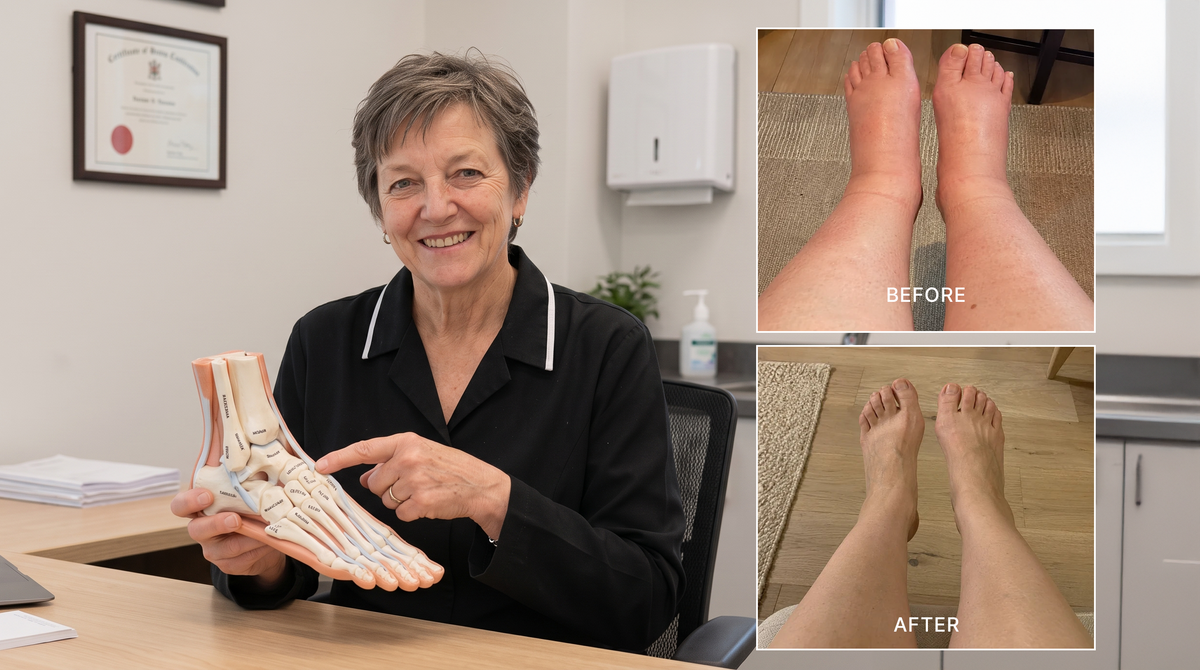
She came into my clinic hopeless, exactly like so many women I had seen before her.
Her name was Sarah, a 48-year-old ward nurse working six days a week, twelve-hour shifts on her feet from the moment she clocked in to the moment she dragged herself home.
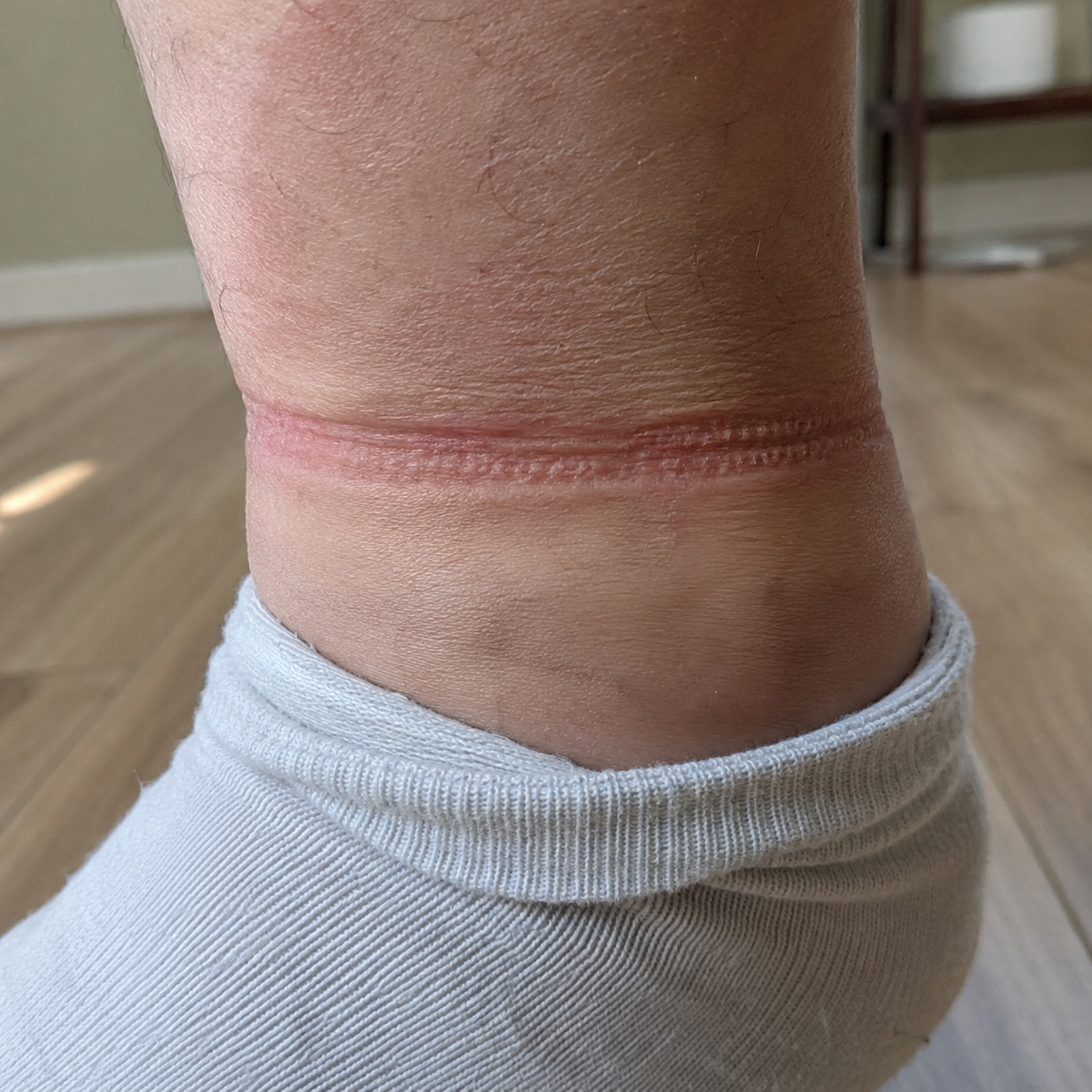
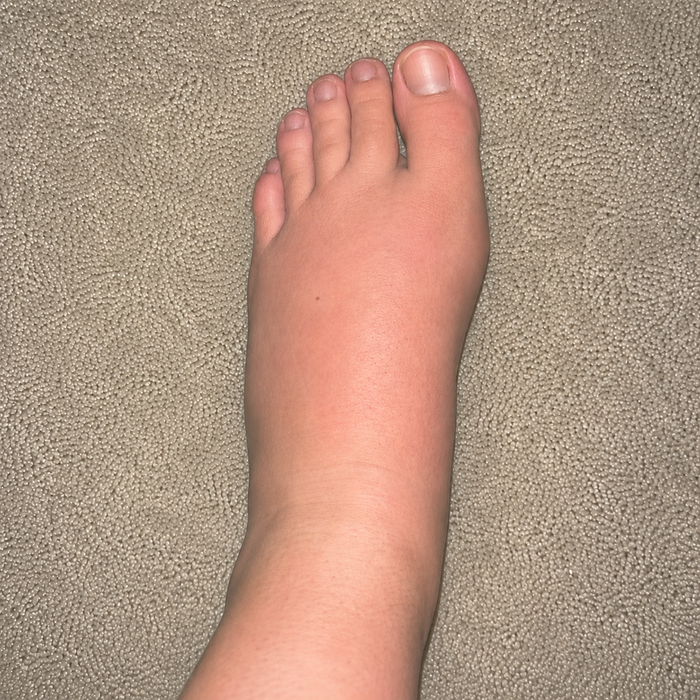
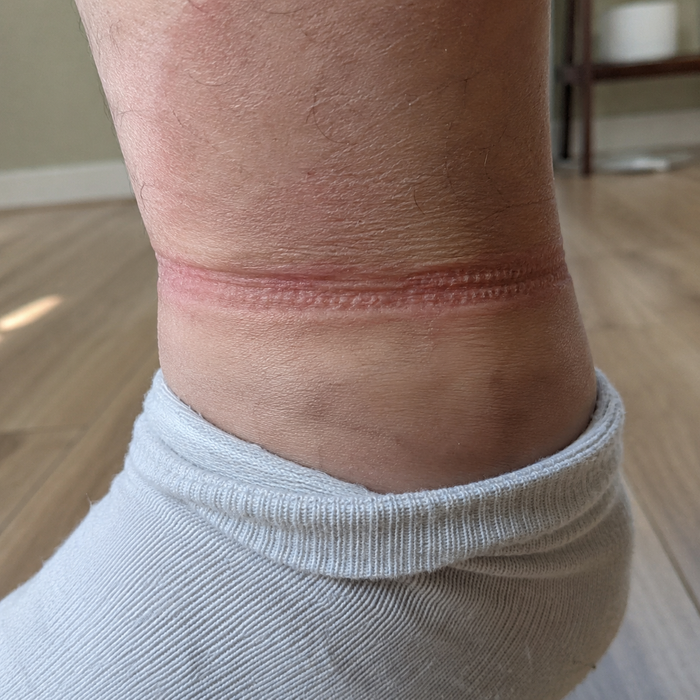
By the end of each shift her ankles had swollen so badly her shoes left deep red grooves in her skin, and her feet throbbed through the night. She had started dreading her alarm, not because she did not love her job, but because she already knew what those twelve hours would feel like before she reached the ward.
She could not remember the last time she came home without collapsing onto the sofa, too exhausted to cook and too sore for the walk she used to enjoy. She felt like her body was quietly being dismantled, one shift at a time.
I have seen nurses in their forties move like women in their sixties. Not because of what they do, but because of what they wear on their feet while they do it.

In sixteen years, I have seen hundreds of women just like Sarah. Nurses. Healthcare assistants. Midwives. Women who spend their entire working lives on hard floors, for other people, and come home with nothing left to give.
I have seen patients with £300 orthopaedic shoes that "should have fixed everything." Custom insoles. Anti-fatigue mats. Ice baths. One patient was having twice-daily foot massages from her husband just to get through the week. She cried in my chair telling me about it.
None of it was working, because nobody, not the shoe shop, not the insole fitter, not the GP, had ever talked to them about what was actually in direct contact with their foot inside that shoe.
So I asked her the question no one had ever thought to ask her
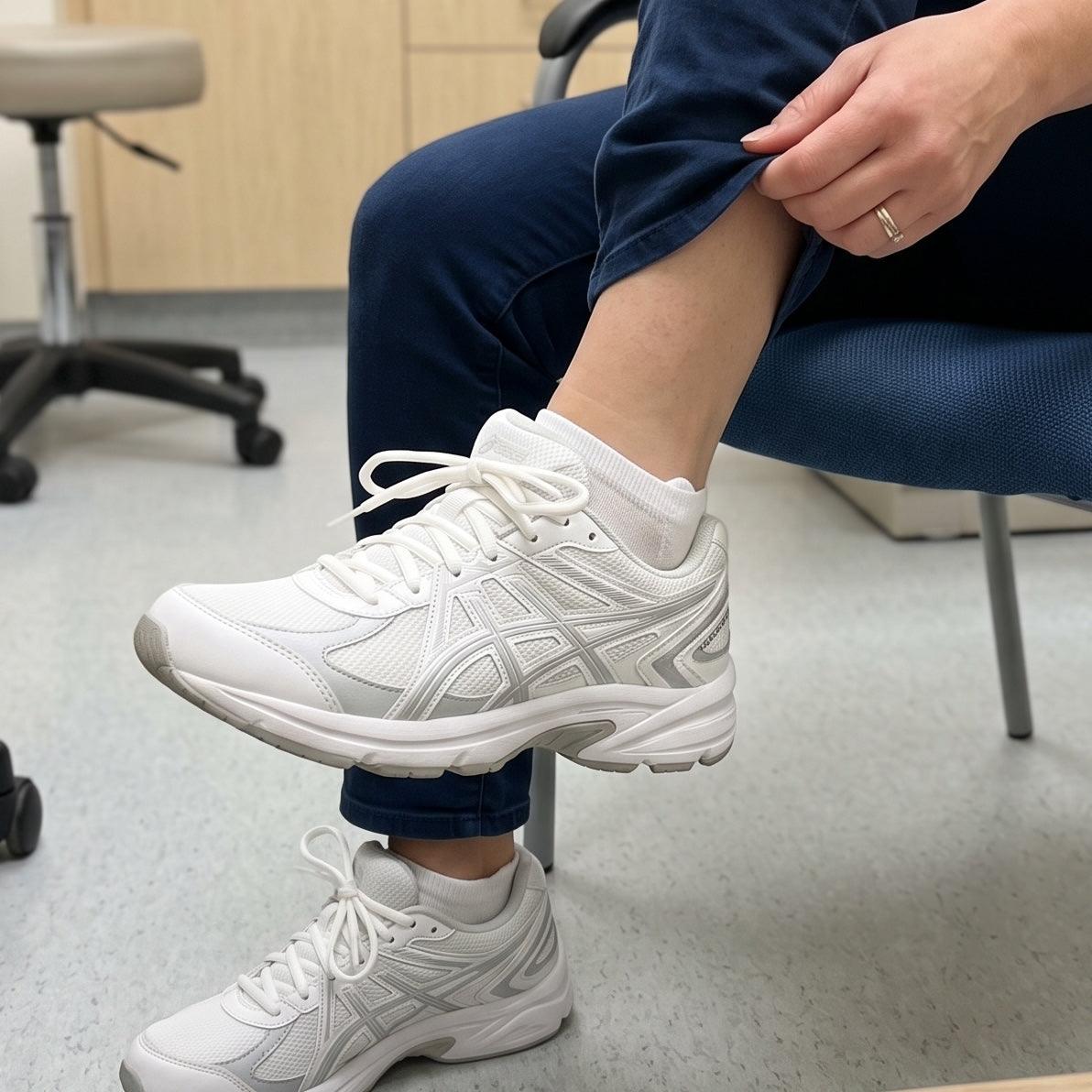
When Sarah sat down, I let her finish her story, then asked her to show me what she was wearing on her feet.
She untied her shoe, a well-known orthopaedic brand, clearly expensive and well-researched, and started explaining it to me before I could say anything. The cushioned midsole. The arch technology. The way the advert had shown a nurse practically floating across a hospital ward.
It felt like a sales pitch, right there in my chair.
I stopped her. "Sarah. I am not asking about the shoe."
She blinked. "Sorry?"
"I am asking about your sock. Inside the shoe."
She reached into her shoe and held up a white ankle sock, the kind you buy in a multipack of ten. Thin. Flat. No structure.
"It is just an ankle sock," she said, almost apologetically. "I always wear these."
"That," I told her, "is exactly the problem."
What every shoe brand hopes quietly you never work out
A shoe can be beautifully engineered, and an insole made from the finest materials on the market, but neither is in direct, uninterrupted contact with your skin.
Your sock is.
And a flat, thin, unstructured ankle sock does three things to a foot that has been standing for twelve hours:
First, it provides zero support to the arch. The arch is the part of your foot that carries the load with every single step. By hour four, it begins to fatigue. By hour eight, it has collapsed. By hour twelve, the entire foot is compensating, and so are your ankles, knees, and lower back.
Second, it does nothing to manage the fluid that accumulates in your lower legs throughout the day. When you stand for prolonged periods, blood and lymphatic fluid pool downward under gravity. Without help pushing that fluid back up the leg, it simply sits there. It swells. It aches. It leaves marks. And by the time you get home, it has been doing that for half a day.
Third, it offers no reinforcement to the heel and toe. These are the two points of impact that take the most punishment with every step on a hard clinical floor. Over months and years, this is how you end up walking like you are twenty years older than you are.
The mechanism you're not being explained
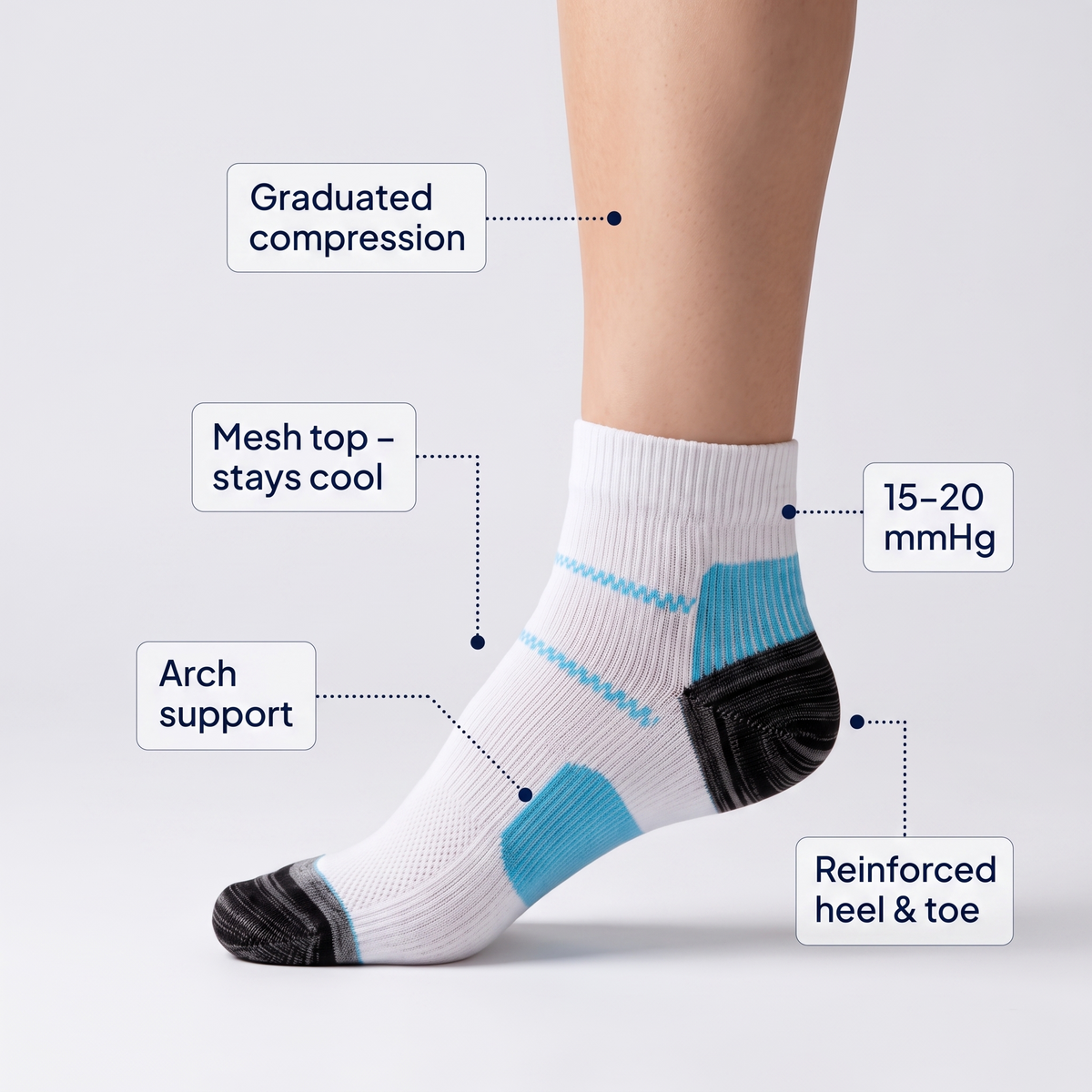
What the foot actually needs during a long shift is something that works with the body's own circulation rather than ignoring it.
A sock engineered with graduated pressure, firm at the ankle and releasing up the calf, acts like a second muscle, helping push pooled blood back up the leg instead of letting it accumulate.
A denser weave at the arch that hugs rather than lies flat gives the foot a structural base no shoe can replicate, since a shoe is fixed geometry and cannot respond to your specific foot.
Add reinforced knit at the heel and toe, and breathable mesh across the top to manage temperature and moisture through twelve hours of clinical work.
The result is a foot that arrives at the end of a shift in a fundamentally different condition. The shoe gets the credit. The sock does the work.
I had one pack left in my drawer.
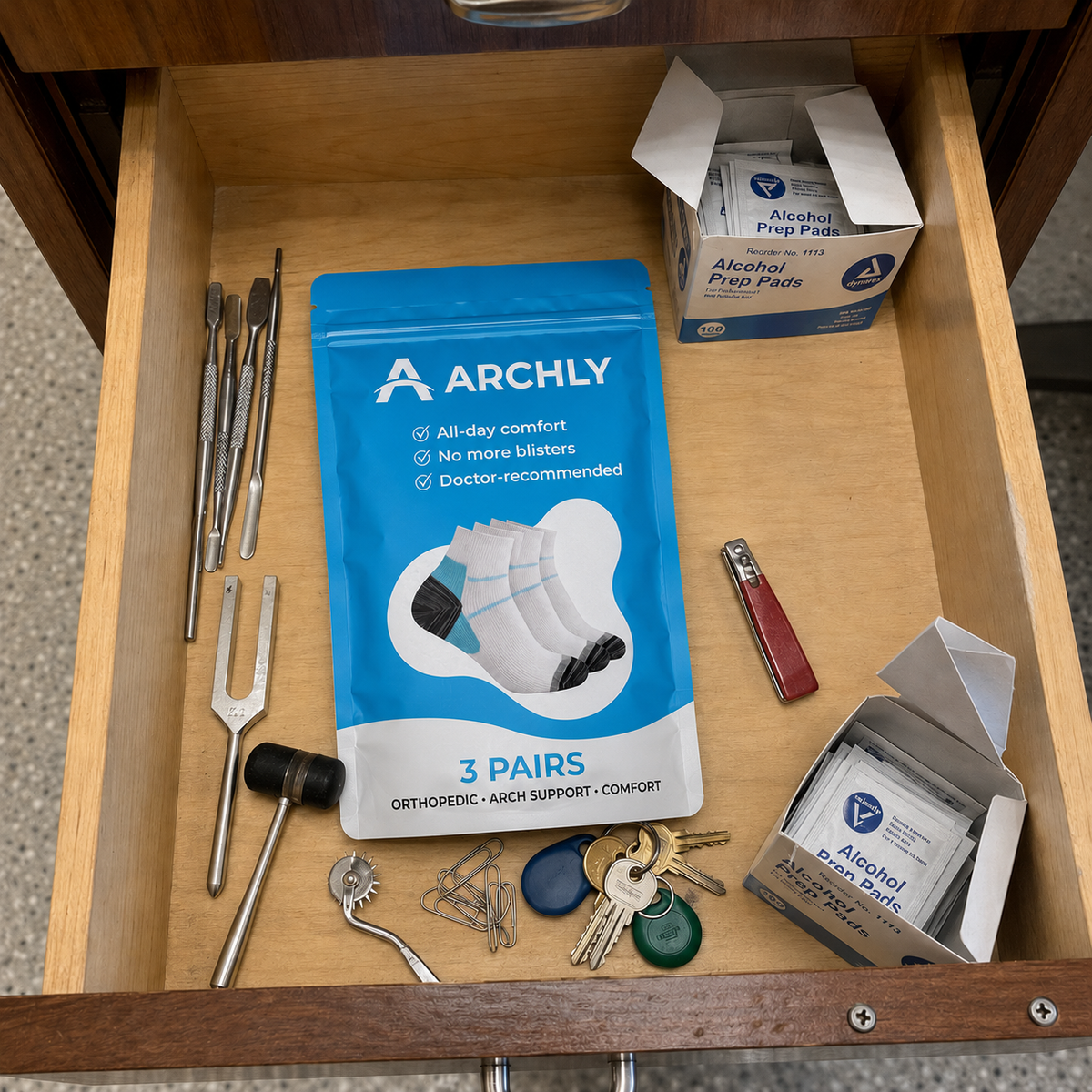
I have had a small drawer in my clinic for years. Not medications. Not expensive devices. Just a few packs of properly engineered compression socks that I keep for patients exactly like Sarah. The kind of patients who have tried everything else and still cannot understand why nothing sticks.
That afternoon, I had one pack left.
I handed them to Sarah, told her to wear them every shift for seven days, and asked her to come back and tell me what happened.
She came back on day five.
She did not wait for day seven.
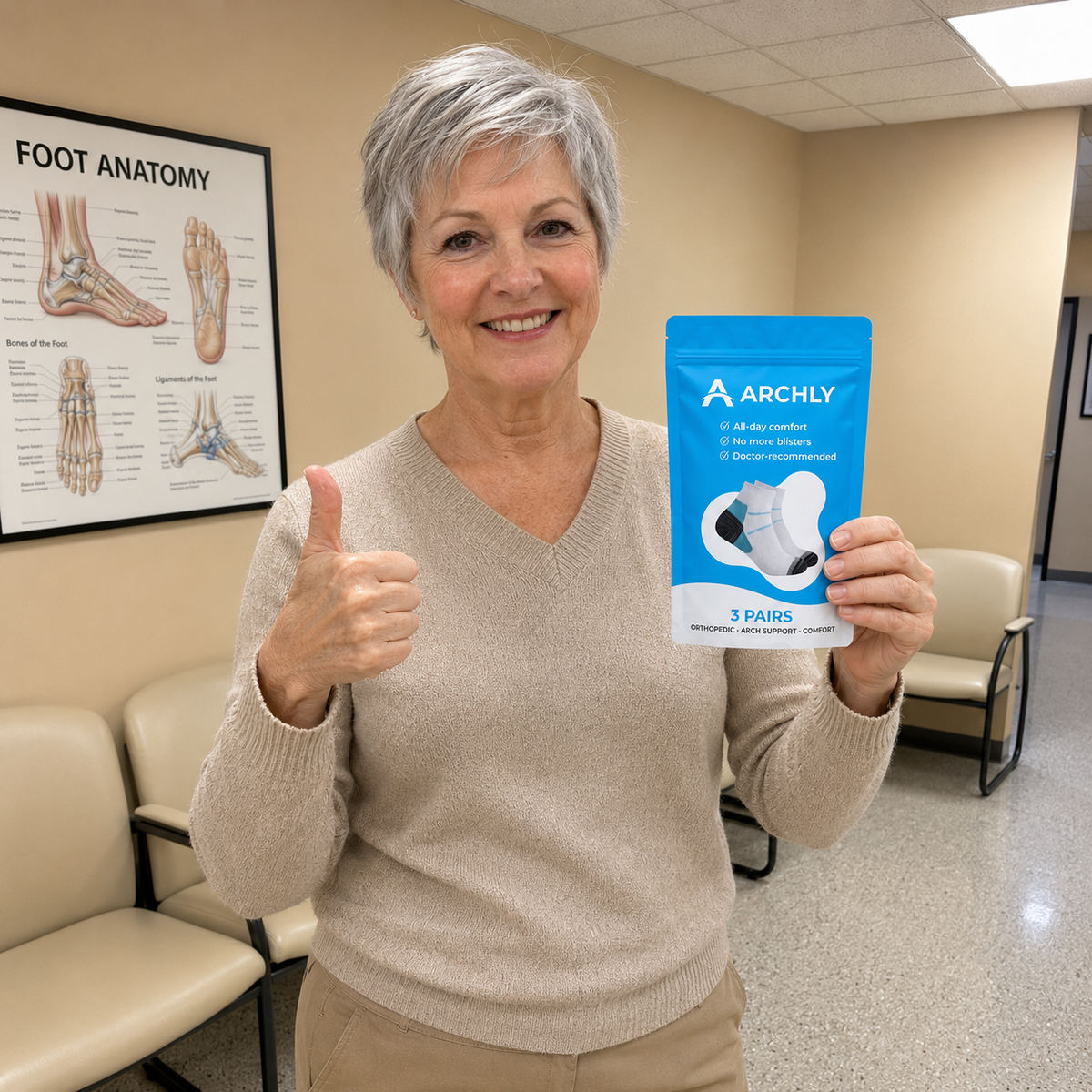
She walked through my door on the fifth morning, and I caught a glimpse of a deep teal edge above her ankle as she sat down. Something about her had settled.
She reached across the desk and held both my hands. "The pain Emma, it's gone," she said.
Not reduced. Gone.
She had finished a full twelve-hour shift on day three and come home and cooked dinner standing at the hob, without thinking about her feet at all. No throbbing. No ache. Just her feet doing what feet are supposed to do.
"It was the sock. All this time."
She had already tracked down the small UK manufacturer and ordered several more pairs. They do not sell wholesale, only direct to customers, a frustration I have heard from colleagues. The socks are increasingly recommended by podiatrists across the country, demand growing quietly by word of mouth from people who could not believe a sock made this much difference.
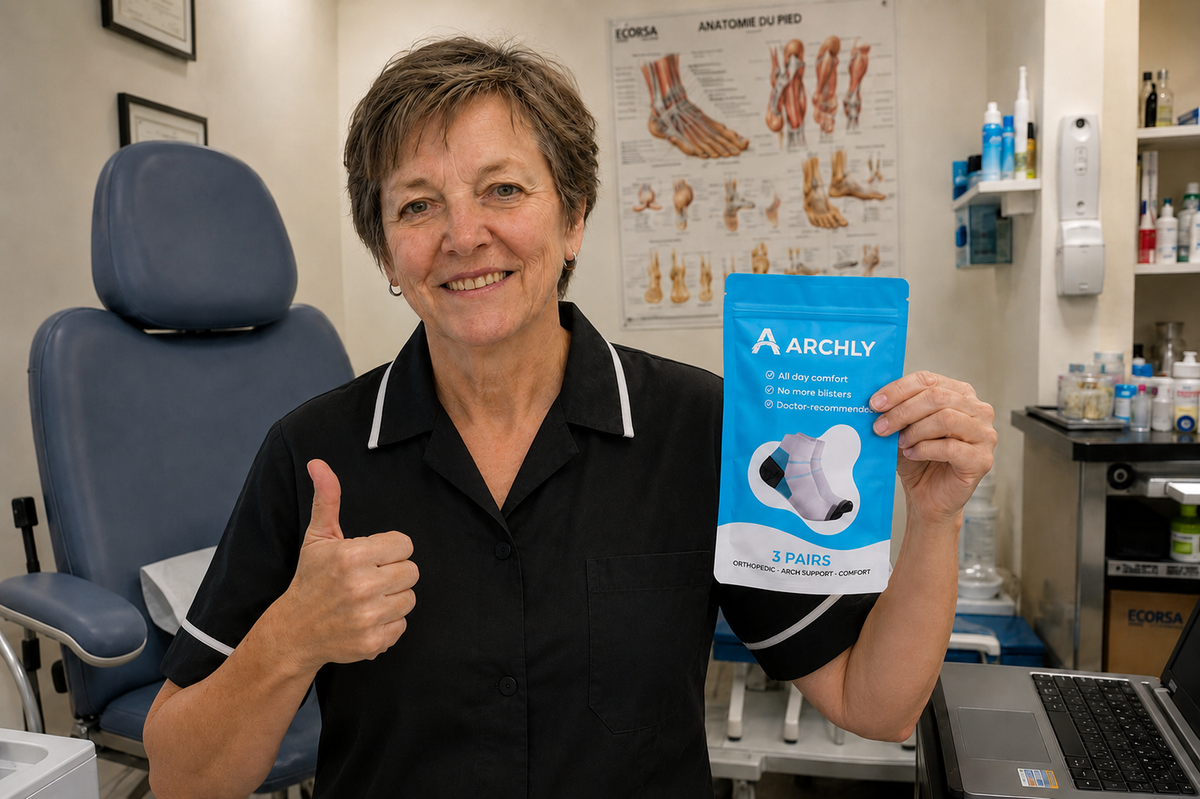
So what do I tell every patient now?
I think about Sarah every time a nurse sits across from me, and I always ask the same question first.
What are you wearing inside that shoe?
After sixteen years, here is what I know: you can put the finest tyres on a car and still wonder why you are not getting anywhere. What sits between the machinery and the ground is what actually makes the difference.
A proper sock inside a proper shoe is what it feels like when everything finally works the way it was designed to.
If you are a nurse, a healthcare worker, anyone who spends their working life on their feet, and you have been telling yourself the aching is just part of the job, that the swelling is normal, that the marks on your ankles are just what happens: it does not have to be that way.
You deserve to come home and still have something left.
I looked up the company, Archly, and saw more reviews similar to hers:
 Before
 After
After“I’ve only ever worn compression socks at work. They help so much with the swelling and pain. If I were standing without them I would be in a lot of pain at the end of every single shift.”
 Before
 After
After“If I don’t wear them my feet always hurt like hell. It is like night and day. I could not believe it was the sock the whole time.”
 Before
 After
After“I started wearing proper compression socks a few months ago and they make all the difference in the world. My legs and feet no longer ache the next day.”
A lot of people have asked me after reading this: where do you actually get them?
The company is called Archly, a small UK brand that makes these socks in limited runs. They sell directly to customers online, not through clinics or retailers, so if you want a pair, you go to them.
After this article started circulating, they reached out to me directly. Demand had come in faster than they could handle, and stock was being snapped up almost as soon as it landed. They are a small operation making a quality product, not a factory pumping out thousands of units a week.
I also asked what happens if someone tries them and is not convinced. They were clear: if you are not happy within 30 days, you get your money back, no awkward process, no questions. So the only real risk here is not trying them at all and spending another six months blaming your shoes.
My honest advice: click the button below and check if they still have stock. If they do, that is your chance. Your feet have carried you through enough shifts already. It is time to give them something back.
Archly contacted us asking whether we could take it down temporarily due to the volume of orders coming in. We declined. That said, I would not sit on this. Stock is limited by design and it moves fast. They back every pair with a 30-day money-back guarantee.

Emma trained at the University of Brighton and has been running her private podiatry practice in South London since 2009. She specialises in working with patients whose occupations place sustained mechanical stress on the feet and lower limbs. Nurses, paramedics, teachers, and retail workers make up a significant portion of her caseload.
Outside the clinic, Emma is a mother of two, an enthusiastic but admittedly mediocre recreational runner, and a firm believer that the most impactful interventions in foot health are almost always the simplest ones.
She does not accept payment from any brand for clinical recommendations, and is particular enough about it that her colleagues have started finding it amusing.

I genuinely never thought it would be the socks. Tried everything, new shoes, insoles, even those compression stockings from the pharmacy that left marks worse than what I started with. My daughter kept telling me to try these and I kept putting it off. Finally ordered a pair and honestly I don't know whether to laugh or cry that it was this simple. Already ordered 3 more pairs because I am not running out 😅

ok so I'm a nurse and I have been complaining about my feet for literally 4 years. four. years. my husband is probably sick of hearing about it lol. started wearing these on Monday and by Wednesday I came home and actually made dinner standing up and didn't even think about my feet until I was eating. that has not happened in so long I can't even remember. just ordered another 2 pairs, not taking any chances

The grooves my old socks left around my ankles every single shift.. I thought that was just normal. I thought that was just what happened when you were on your feet all day. These don't do that. My ankles look normal at the end of a 12 hour shift. I actually cried a little bit the first time I noticed. Might be dramatic but if you're a nurse you'll understand

Wish someone had told me about these years ago honestly. Been through 3 different pairs of "supportive" shoes, two sets of custom insoles and nothing really worked. These were like 14.- or something and I feel like im walking on clouds the entire shift. Already on my second order. Feel abit silly that it was the socks all along but here we are 😂

Not someone who usually leaves reviews but felt like I had to. 12 hour shifts in A&E, been doing it for 9 years and the last 3 have been really hard on my legs and feet. A colleague mentioned these and I was skeptical tbh. Wore them for the first time last Thursday and came home and went for a walk. Went for a walk!! After a 12 hour shift. My husband thought I'd lost the plot. I've since ordered 4 more pairs and told everyone in my ward about them

dont normally write these things but my feet have been so bad lately I was actually considering whether I could keep doing this job. Started wearing these 2 weeks ago and the difference is unreal. No more swelling, no more that horrible throbbing at night. Honestly thought the aching was just part of being a nurse. It doesnt have to be. Get them, seriously